Yogyakarta, 28 August 2026 — Breast cancer remains one of the major global health challenges. According to data from the Global Cancer Observatory (GLOBOCAN) 2022, approximately 2.3 million new breast cancer cases and 670,000 deaths were reported worldwide. The incidence continues to rise, particularly in developing countries such as Indonesia. One subtype of particular concern is Triple-Negative Breast Cancer (TNBC), which is characterized by its aggressive nature and high potential for metastasis.
Chemotherapy remains one of the main treatment modalities for cancer, including TNBC, due to the limited availability of effective targeted therapies. However, its use faces several challenges, including the risk of drug resistance and widespread systemic effects. These challenges have encouraged the exploration of natural resources as potential sources for discovering new cancer therapeutic candidates.
In response to this challenge, students from Universitas Gadjah Mada (UGM), under the supervision of dr. Dwi Aris Agung Nugrahaningsih, M.Sc., Ph.D., are conducting research through the Student Creativity Program for Exact Sciences Research (PKM-RE) under the project BIXINHOPE. The team is led by Haafizh Azmi Khairiil Qais, with members Amyra Salma Arma Putri, Pradipta Ayman Subagyo, and Jasmine Allisya Zahwa from the Faculty of Medicine, Public Health, and Nursing, as well as Madeline Manik from the Faculty of Pharmacy. The team is exploring the potential of lipstick tree seeds (Bixa orellana) as a candidate for breast cancer treatment.
Lipstick tree seeds (Bixa orellana) are considered a promising natural resource due to their bioactive compounds, including bixin and norbixin, which have demonstrated various biological activities. Through BIXINHOPE, the team is investigating their potential as anticancer candidates, particularly against TNBC.
“Lipstick tree seeds are being developed in this research as a potential adjuvant therapy, not as a replacement for chemotherapy. This research represents an initial step in exploring their potential as an anticancer candidate that can be further developed,” said Haafizh Azmi Khairiil Qais, leader of the BIXINHOPE team.
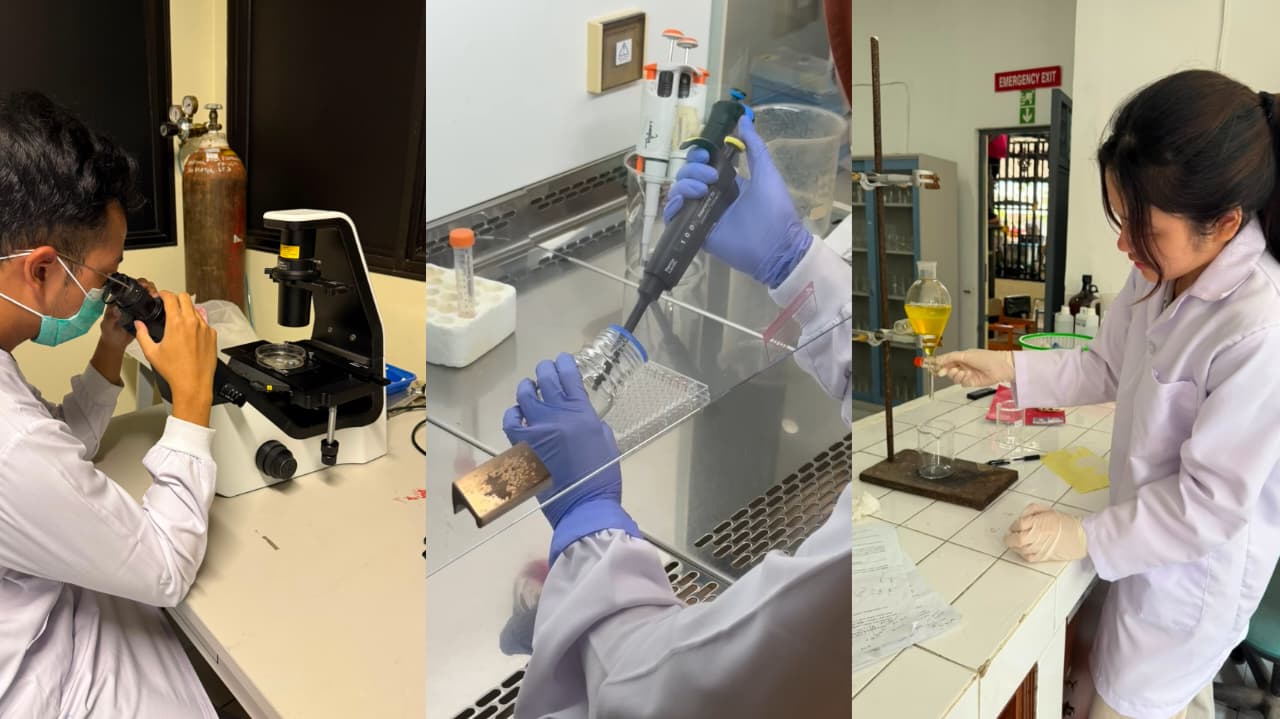
The research focuses on Matrix Metalloproteinase-9 (MMP-9), a protein involved in cancer cell migration and metastasis. The effects of Bixa orellana on MMP-9 expression are being investigated in MDA-MB-231 breast cancer cells through both in silico and in vitro approaches.
The research is being conducted in stages, beginning with an in silico approach to predict the interactions between bioactive compounds from Bixa orellana and the MMP-9 target protein. The study has now progressed to the in vitro stage, in which lipstick tree seed extract is being tested on MDA-MB-231 breast cancer cells to examine its effects on cell viability, migration, and the expression of related genes.
BIXINHOPE also contributes to the Sustainable Development Goals (SDGs), particularly SDG 3: Good Health and Well-being, through the exploration of potential breast cancer therapeutic candidates; SDG 9: Industry, Innovation and Infrastructure, through the development of natural resource-based innovation and biomedical technology; and SDG 12: Responsible Consumption and Production, through the sustainable utilization of natural resources for the development of anticancer candidates.
As part of UGM students’ efforts to explore Indonesia’s rich biodiversity, this research is expected to serve as an initial step toward further investigating Bixa orellana as a potential anticancer candidate, particularly in addressing the challenges associated with TNBC. In line with the slogan “Small Seed, Big Hope Against Breast Cancer,” BIXINHOPE carries the hope that a small seed can inspire meaningful innovation for human health.
Writer: Madeline Manik | Editor: Fathul | Photo: Madeline Manik