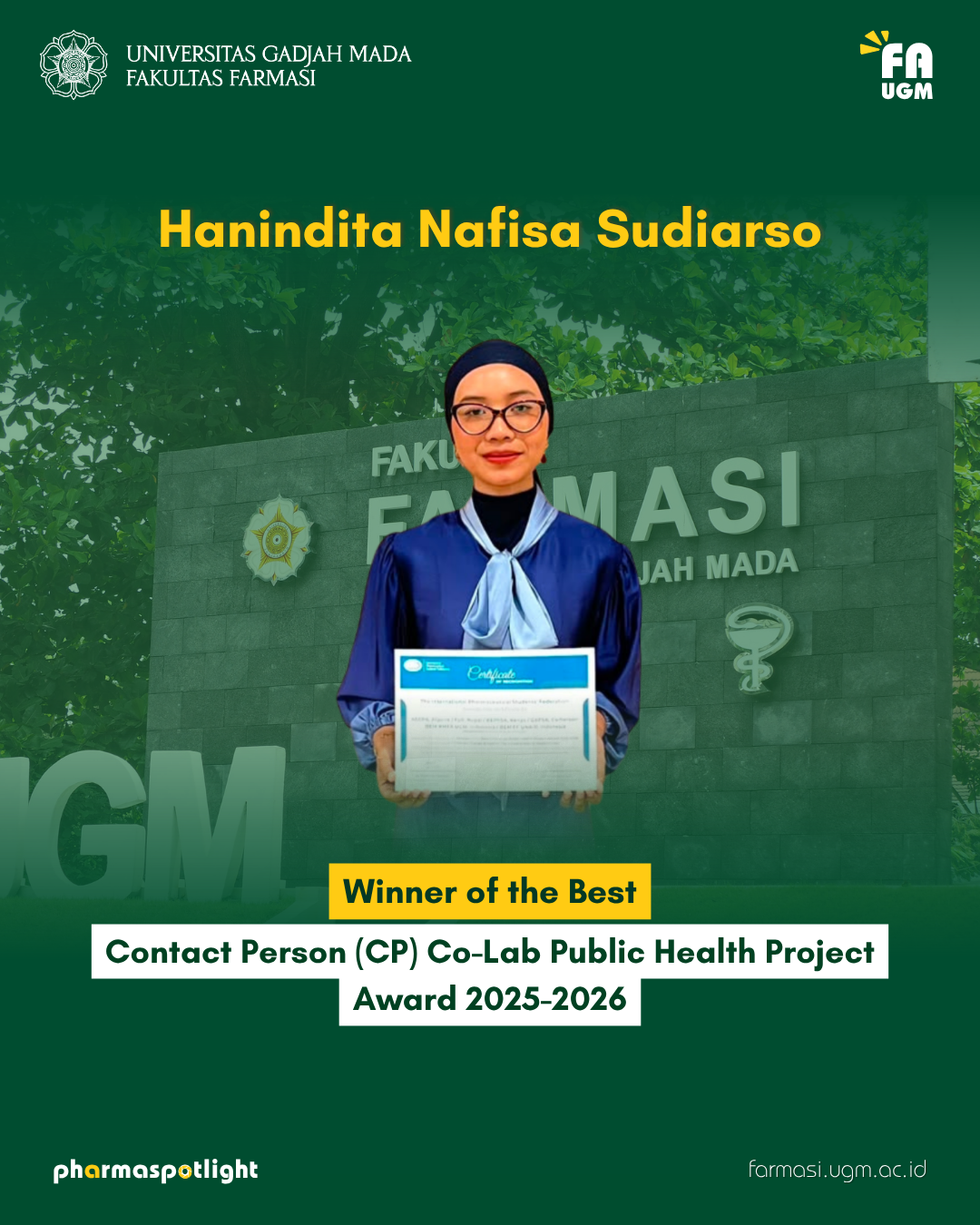
Yogyakarta, September 28, 2026 — The Student Executive Board of the Faculty of Pharmacy Student Association at Gadjah Mada University (BEM KMFA UGM) has achieved a remarkable accomplishment on the international stage. In her role as the Contact Person (CP) for BEM KMFA UGM Indonesia, Hanindita Nafisa Sudiarso led the student organization to win the “Winner of the Best CP Co-Lab Public Health Project Award 2025–2026” from the International Pharmaceutical Students’ Federation (IPSF). This prestigious award was presented during the IPSF World Congress 2026, held in Bangkok, Thailand.
The CP Co-Lab Project is a strategic initiative of the IPSF that brings together Contact Persons from various Member Organizations (MOs) around the world to collaborate on developing international projects. This initiative focuses on four main pillars: Public Health, Professional Development, Policy and Advocacy, and Pharmacy Education.
Under the Public Health pillar, Hanindita Nafisa Sudiarso, as a representative of BEM KMFA UGM, collaborated across national borders with other international pharmacy student organizations, namely ASEPA (Algeria), the Faculty of Pharmacy (Nepal), KEPhSA (Kenya), CAPSA (Cameroon), and BEM FF UNAIR (Indonesia). This multinational collaboration successfully initiated and designed a project titled “Climate Change & Health: The Invisible Mental Health Crisis.”
This collaborative project addresses a critical issue regarding the impact of climate change on mental health, particularly the phenomenon of psychological stress that is increasingly being experienced by young people around the world. Through its campaigns and educational programs, the team aims to raise global awareness of the close link between the climate crisis and mental health challenges that often go unnoticed.
Thanks to its innovation, the depth of its content, and the effectiveness of its international collaboration, this project was named the best in its category. This achievement not only brings pride to the UGM Faculty of Pharmacy and Indonesia, but also demonstrates the ability of Indonesian pharmacy students to lead initiatives and respond to global health issues in a tangible way.
This achievement also supports the Sustainable Development Goals (SDGs), particularly SDG 3 (Good Health and Well-being) through addressing mental health crises, SDG 13 (Climate Action) through education on the impacts of the climate crisis, and SDG 17 (Partnerships for the Goals) through strengthening cross-national collaboration among pharmacy students. It is hoped that this success will serve as an inspiration and a source of motivation for all students in the UGM Faculty of Pharmacy to continue honing their competencies, expanding their global networks, and actively contributing to solving various public health challenges on a global scale.
Contributor: UGM Pharmacy Student Executive Board | Editor: Fathul