Yogyakarta, August 24, 2026—Meat consumption continues to play an important role in meeting the nutritional needs of Indonesian communities, with broiler chicken meat among the most widely consumed types of meat. In 2025, broiler chicken meat consumption reached 13.60 kg per capita per year (Directorate General of Livestock and Animal Health, Ministry of Agriculture, 2025), while its availability reached 15.29 kg per capita per year (National Food Agency, 2025). This high level of consumption and availability needs to be accompanied by proper quality monitoring, as chicken meat is highly perishable, while its freshness is still often assessed subjectively through sensory observation.
Addressing this issue, a team of Universitas Gadjah Mada (UGM) students participating in the Student Creativity Program for Entrepreneurship (PKM-K), under the supervision of apt. Purwanto, M.Sc., Ph.D., has developed SEFTIN, an edible film designed as a freshness indicator for high-protein foods, particularly chicken meat. The innovation is made from natural materials, namely sago starch and anthocyanin extract derived from purple sweet potatoes.
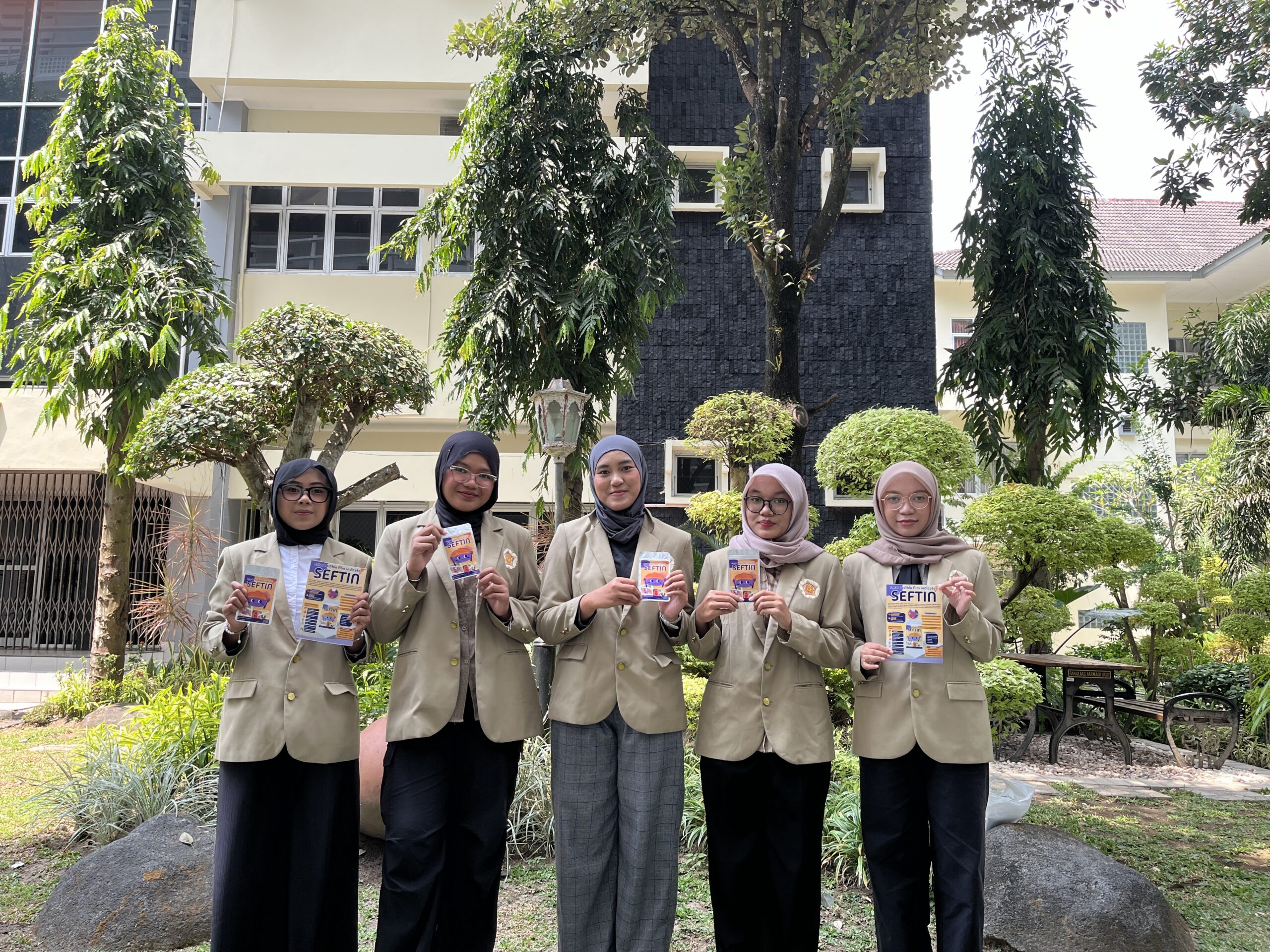
The innovation was developed by five female students: Novita Nurul Latifa, Nabila Aurora Banuwati, Nabila Putri Herviana, and Andinar Zahranayla Y. from the Faculty of Pharmacy, along with Asa Nanda Fitria from the Faculty of Agricultural Technology.
“SEFTIN works in a fairly simple way. Food freshness can be detected through changes in the color of the edible film, which can then be matched with a color-scale sticker integrated into the indicator. This allows users to monitor the freshness of food in real time simply by observing the color change,” said Novita Nurul Latifa, leader of the SEFTIN team (August 17).
The SEFTIN team carried out the PKM-K activities through a gradual and structured process, beginning with a literature review as the foundation of the research. This was followed by a preliminary survey involving respondents from various professional backgrounds to identify market needs. The subsequent stages included repeated product formulation trials to determine an effective formulation, followed by production, product testing, and finally product introduction and marketing to the public.
SEFTIN was developed in the form of a sticker to improve practicality, ease of use, and the effectiveness of freshness monitoring. The sticker can be attached to the lid of packaging, such as thin-wall containers, allowing the indicator to remain visible from the outside without requiring the package to be opened.
Testing results showed that the sago-starch-based edible film containing purple sweet potato anthocyanin extract was able to display consistent color changes corresponding to the decline in chicken meat freshness. This response occurs because anthocyanins are sensitive to changes in pH, enabling them to visually indicate chemical changes occurring on the surface of the meat during storage.
“At present, SEFTIN can only be used to detect the freshness of chicken meat, but it has the potential to be further developed for other high-protein foods,” said Novita Nurul Latifa, leader of the SEFTIN team (August 17).
Overall, the SEFTIN production process consists of three main stages: maceration of purple sweet potatoes to obtain anthocyanin extract, fabrication of the edible film using sago starch as the film-forming matrix, and integration of the film with a sticker to facilitate its application.
The innovation also contributes to the achievement of the Sustainable Development Goals (SDGs), particularly SDG 3 (Good Health and Well-being) by helping prevent consumers from eating chicken meat that is no longer safe for consumption; SDG 9 (Industry, Innovation and Infrastructure) through the development of a practical, natural-material-based food freshness indicator with commercialization potential; and SDG 12 (Responsible Consumption and Production) by promoting more objective food quality monitoring while potentially reducing food waste caused by uncertainty in determining product freshness.
In line with SEFTIN’s slogan, “See Freshness, Trust Quality,” the product is expected to continue developing into a practical, affordable, and user-friendly commercial product for both consumers and food businesses. Further development is expected to enhance its technological readiness and expand the application of SEFTIN as a more objective, sustainable, and reliable innovation for monitoring meat freshness.
Writer: Andinar Zahranayla Y. | Editor: Fathul | Photo: SEFTIN PKM Team