Yogyakarta, 28 August 2026 – Five students from Universitas Gadjah Mada (UGM), representing the Faculty of Pharmacy and the Faculty of Medicine, Public Health, and Nursing, have developed Levocross, a research project exploring a levofloxacin-based drug delivery system to support the development of tuberculosis (TB) treatment. The team consists of Desrika Dwi Handayani and Fatharani Hasya Tsabita from the Faculty of Pharmacy, and Alphatar Magnus Jonathan Tambunan, Emeliana Putri Ayu Ningsih, and Ernestus Revan Yogantara Arjuna from the Faculty of Medicine, Public Health, and Nursing. The research is supervised by Dr.rer.nat. Ronny Martien, M.Si., from the Faculty of Pharmacy UGM.
Levocross was developed through the 2026 Student Creativity Program for Exact Sciences Research (PKM-RE). The research focuses on developing Hyaluronic Acid-Nanostructured Lipid Carrier-Levofloxacin (HA-NLC-LFX), a delivery system combining levofloxacin as the active pharmaceutical ingredient, Nanostructured Lipid Carrier (NLC) as the delivery vehicle, and hyaluronic acid (HA). The formulation is being developed for administration through inhalation as an approach to deliver the drug to the lungs.
Levofloxacin (LFX) was selected as the active pharmaceutical ingredient incorporated into the Levocross delivery system. Under certain circumstances, levofloxacin may be used as a second-line drug in tuberculosis treatment. In this research, the team is not only focusing on the use of levofloxacin as an active ingredient, but also exploring how the drug can be formulated into a delivery system to support pulmonary administration through inhalation.
To deliver levofloxacin, the team developed a Nanostructured Lipid Carrier (NLC), a nano-sized lipid-based delivery system. The NLC is then combined with hyaluronic acid on its surface to form the HA-NLC-LFX formulation. Several formulation variations are being evaluated to characterize the resulting systems and identify the most suitable formulation for further testing.
“Through Levocross, we aim to explore how drug delivery systems can be developed by considering the site of infection and target cells involved in tuberculosis. As the research is still ongoing, the various tests we conduct are an important part of identifying the most optimal formulation,” said Alphatar Magnus Jonathan Tambunan, a member of the Levocross team.
The formulation development begins with the hot emulsification-ultrasonication method. The components used to form the NLC and the levofloxacin are processed through heating and mixing, followed by homogenization and ultrasonication to produce a nano-sized system. Hyaluronic acid is then added in several variations to produce the HA-NLC-LFX formulations. The resulting formulations undergo a lyophilization process before being used for subsequent characterization and testing.
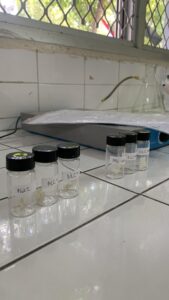
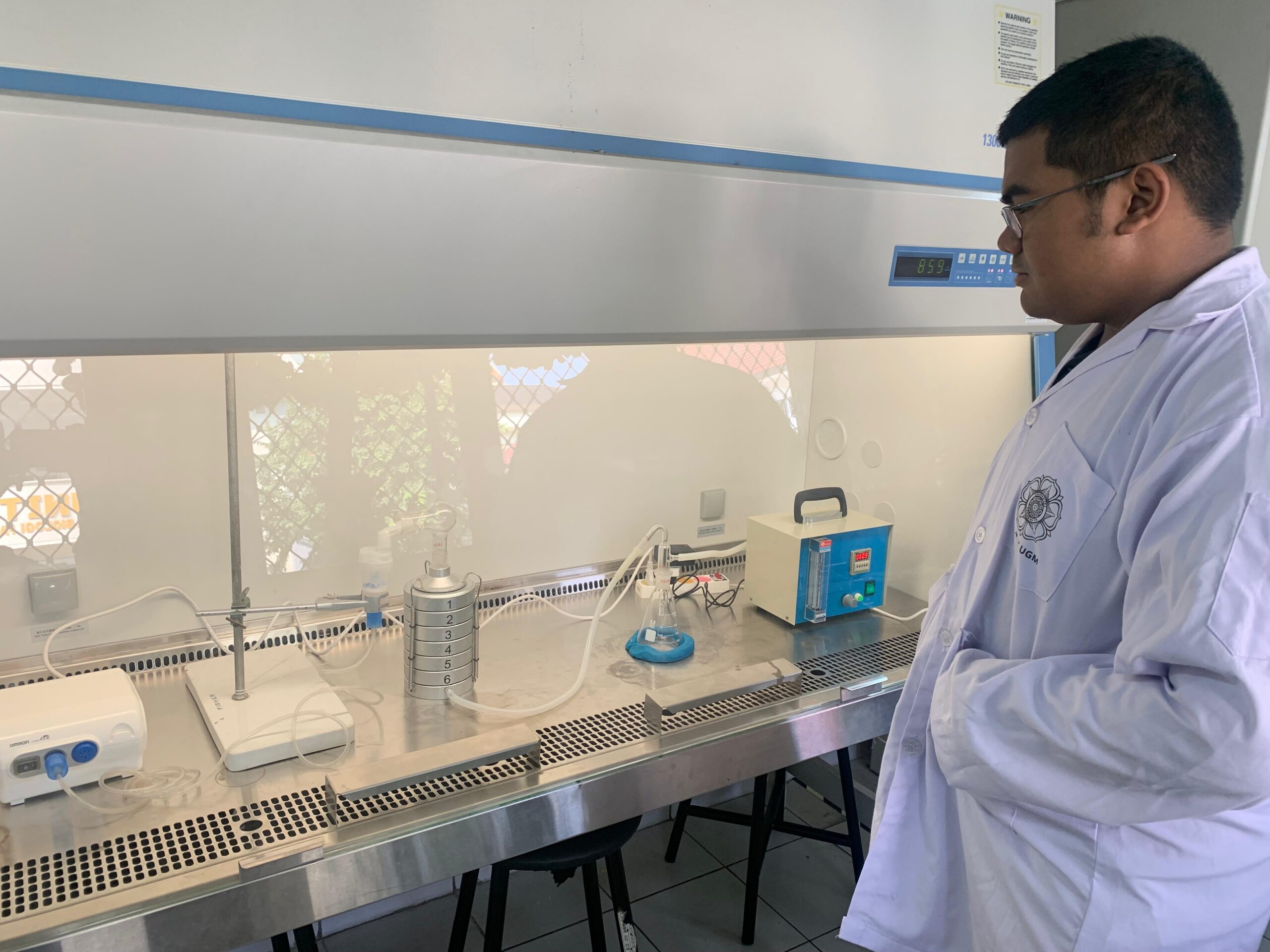
Characterization is conducted to evaluate various properties of the formulations, including drug loading, particle size and uniformity, surface potential, pH, and morphology. The team also evaluates the stability of the formulations and the release profile of levofloxacin. In addition, the ability of the formulations to generate aerosols using a nebulizer is tested as part of the development of the inhalation-based delivery system. In vitro testing is also conducted to assess the formulation’s ability to interact with and enter cells.
The development of Levocross contributes to several Sustainable Development Goals (SDGs). The research supports SDG 3: Good Health and Well-being through the exploration of innovative approaches to tuberculosis treatment. It also aligns with SDG 4: Quality Education, as the project provides students with opportunities to apply their knowledge and develop research skills in pharmaceutical and health sciences. Furthermore, the development of a nanoparticle-based drug delivery system contributes to SDG 9: Industry, Innovation and Infrastructure by advancing technological innovation in healthcare.
Currently, Levocross remains in the testing and analysis stage. Data obtained from the various characterization and evaluation processes will be used to determine the optimal formulation and further assess the potential of the levofloxacin delivery system for inhalation. Through this research, the team hopes to further develop Levocross as an innovative approach to drug delivery while strengthening the role of students in advancing research in pharmaceutical and health sciences.
Writers:
- Desrika Dwi Handayani – Fakultas Farmasi
- Fatharani Hasya Tsabita – Fakultas Farmasi
- Alphatar Magnus Jonathan Tambunan – FKKMK
- Emeliana Putri Ayu Ningsih – FKKMK
- Ernestus Revan Yogantara Arjuna – FKKMK
Editor: Fathul